
Flood and Fire Risk Mitigation in Wetlands Using MicroWire Sensing (FF-RIWER)
Leading provider of IoT-based flood monitoring systems. Our mission is to raise awareness about the dangers of floods and to help communities prepare and protect themselves. With a state-of-the-art system that integrates advanced sensors, data analytics, and cloud-based communication, we offer real-time monitoring of water levels and alerts to potential flood threats. Our goal is to reduce the impact of floods on communities and help keep people safe. With our innovative technology, we’re making a significant contribution to improving flood response and prevention efforts.


Laurențiu Boicescu, ACC team lead
In FF-RIWER we combine the RVMagnetics environmental sensors (a HUBCAP asset) with newly created software modules for communication, data storage and processing and visual data presentation (alerts, history etc) for a new CPS solution to be used in use cases related to wetlands (and envisioned to be first deployed in the Romanian Danube Delta). RVM’s technology allows for precise fire and flood sensing with little energy consumption and small, unobtrusive devices, making it ideal for the fragile wetland ecosystem.

Eduard-Cristian Popovici, CEO of ACC
We envision the FF-RIWER platform will be the starting point of the larger DeltaProEco solution for monitoring and performing ecological actions in the Romanian Delta, opening up a host of opportunities for increasing our competitiveness on the local and European market

Vladimir Marhefka, ViceChairman of The Management Board of RVMagnetics
The main benefits RVM gained from participating in the EXPERIMENT was to advance our own technology by employing multiple MicroWires and coils for precise position (water level) measurement and proving its adaptability to wetlands, broadening the company portfolio and also having completed the validation of the technology in real scenarios.

Kornel Richter, Technology Lead of RVMagnetics
With the ACC software solution RVM is now also able to simultaneously run sensors placed in multiple locations

Problem and solution
Wetlands are fragile ecosystems that are susceptible to harm from different environmental threats. Bush fires can destroy bird hides, trees, and boardwalks, and in general fragment the habitat and increase pollution. Also, floods in wetlands cannot provide the same habitats and functions, resulting in loss of wetland vegetation and hampering transport of the native human population within the area. Thus, fire and flood are two main threats to wetlands.
The FF-RIWER experiment targeted the integration of a CPS technology, namely MicroWire Sensing technology, offered by RVM and available as a HUBCAP asset, into a new MBD-augmented modular CPS solution (DeltaProEco) for flood and fire risk mitigation in wetlands, to be implemented by ACC.
The DeltaProEco solution integrates RVM’s CPS technology and is validated by the FF-RIWER set of experiments. DeltaProEco will support two novel fire and flood sensors based on MicroWire sensing technology, customized for wetlands, and will process real-time data using business intelligence tools, to provide valuable input such as sudden increase in temperature and water level. This input will then be used by a visual alerting module to provide output to monitoring components available to a wetland administering authority for better crisis assessment and early response to wetland threats.
FF-RIWER Partner
RVMagnetics R&D company
RVmagnetics has developed the smallest passive sensor in the world thinner than a human hair (20 micrometers) – MicroWire – a contactless sensor that measures pressure, temperature, magnetic field directly and indirectly also torsion, position, vibration, etc. Contactless measuring is based on MicroWire technology and magnetic fields, with no need for powering the sensor. Sensors can withstand harsh acidic and alkaline environments, provide accurate data for a period longer than a lifetime and survive temperature up to 600 degrees without losing its accuracy. Sensors can produce accurate data even when placed in a noisy electro-magnetic environment. Sensing distance range is up to 10cm. Integrating a MicroWire sensor does not add weight to the material nor changes its mechanical properties. The MicroWire sensor helped overcome sensing obstacles in Healthcare, IoT, Industry 4.0, Automotive, Aerospace, Structural Health Monitoring, Electric motors manufacturing, etc.
What we did
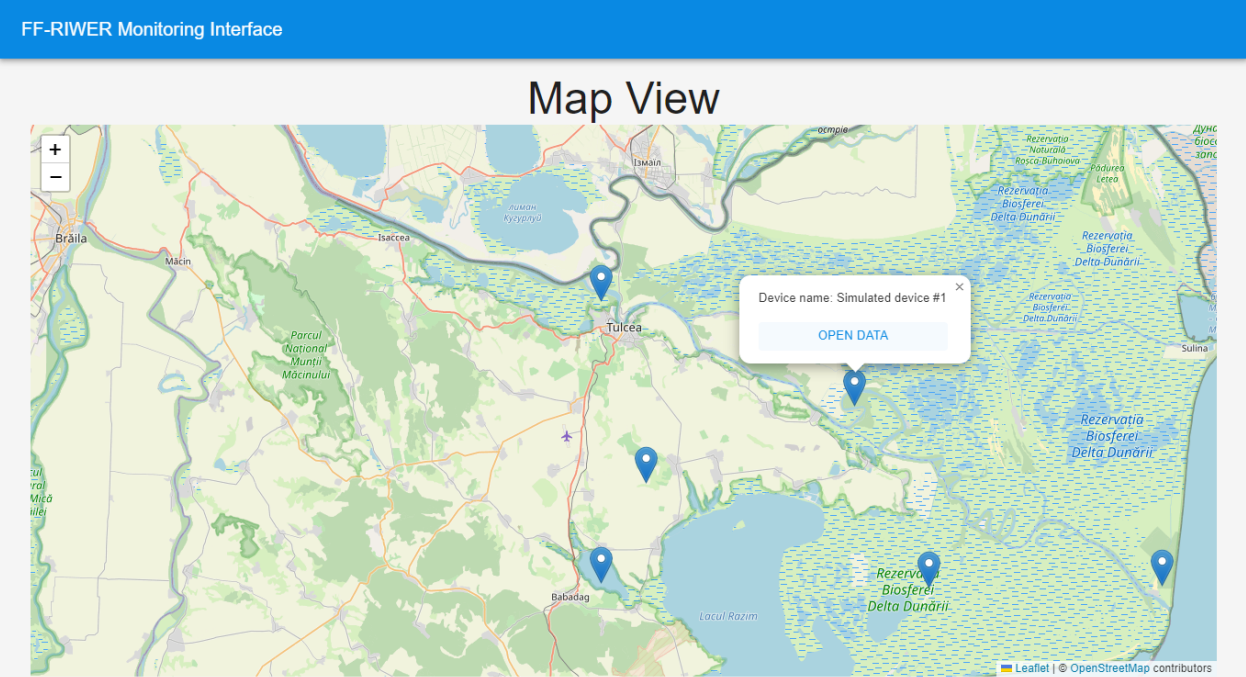
ACC developed and organised the software components of FF-RIWER in a dockerized software stack, allowing rapid automatic restoration of service in case of fault (e.g. power failure). The stack consists of a gateway for sending messages from the MicroWire sensors, a server-side client for reading measurements, tools for enabling a server, a database, and a visualisation component. The software stack has been developed in collaboration, using the GitHub platform.
RVM designed, constructed, calibrated, and validated the MicroWire sensor, which provides accurate measurements of water level and temperature in real-time. The sensor is based on amorphous glass-coated magnetic MicroWires, uses a data acquisition device designed and produced by RVM that contains a set of sensing and excitation coils, a PCB with amplifiers and filters, and a Nucleo chip with operating software. The Nucleo chip communicates by the UART port with a wireless transmitter that sends data to the server.
Consortium members performed two types of experiment:
- In the first experiment, the water level was increased from 0cm to 23cm, then continuously decreased from 23cm down to 0cm.
- Validation of the temperature sensor by heating the sensor with a hand-dryer, then cooling it down to the ambient temperature.
Consortium members performed 2 types of experiments: a water level increase from 0cm to 23cm and continuously decreased from 23cm down to 0cm and heating the sensor by hand-dryer, and cooling it down to ambient temperature. All KPIs and milestones were successfully validated.
Thanks to the project RVM formed a partnership with a company that allowed the integration of their sensor to a broader robust multi-installation platform allowing flood and fire mitigation. For ACC the success of the FF-RIWER experiment is crucial for further developing the company and enabling the DeltaProEco solution for the Romanian Delta.
The funding received from HUBCAP allowed the companies to develop a new CPS solution benefitting from both companies’ know-how and to add it as a new tool in the HUBCAP catalogue.

Video
Watch It In Action
HUBCAP support and platform opportunity
The HUBCAP platform allowed the preparation of ACC software and its interaction with RVM hardware sensors, and enabled a smooth integration between the products of the two companies. The possibility of adding the FF-RIWER solution as a new tool in the HUBCAP catalogue brings further visibility and opportunities for ACC and its products and services. The funding from HUBCAP allowed both companies to develop their respective technologies further and also to develop a new CPS solution that benefited from their collaboration.